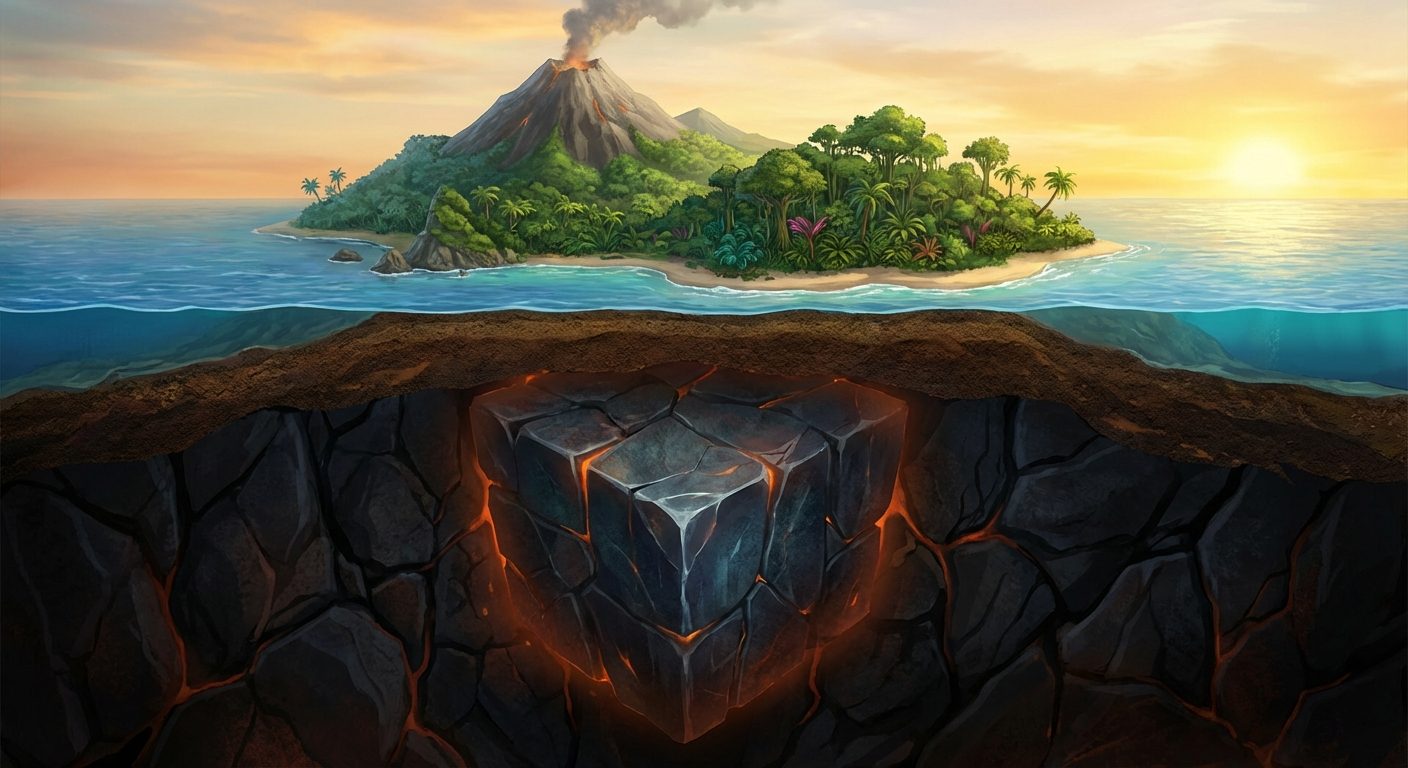
Beneath the tropical islands of Hawaii lies a geological mystery that scientists have been trying to solve for decades. Recent discoveries suggest that a colossal block of rock buried deep underground might finally answer one of volcanology's most puzzling questions: why do volcanic hotspots remain so remarkably stable over millions of years?
The Hawaiian Hotspot Enigma
The Hawaiian Islands represent one of Earth's most fascinating geological features. Unlike most volcanoes, which form at tectonic plate boundaries, the Hawaiian volcanoes emerged from a stationary hotspot in the Earth's mantle. This hotspot has been feeding magma to the surface for roughly 70 million years, creating an impressive chain of islands and seamounts stretching across the Pacific Ocean.
What makes this phenomenon so intriguing is its consistency. The hotspot has remained virtually fixed in position while the Pacific Plate moves over it at a rate of approximately 7 to 9 centimeters per year. This geological conveyor belt has created a timeline of volcanic islands, with older islands to the northwest and younger, more active volcanoes to the southeast.
However, scientists have long wondered about the mechanism that keeps this hotspot anchored in place. Why doesn't it drift with the plate? What maintains its position so precisely?
Discovering the Deep Structure
Recent seismic imaging studies have revealed something extraordinary lurking beneath Hawaii's surface. Researchers using advanced tomography techniques have identified an enormous block of unusually dense material embedded in the Earth's mantle, located approximately 300 to 600 kilometers below the islands.
This massive structure appears to be fundamentally different from the surrounding mantle material. Its composition and density suggest it could be ancient oceanic lithosphere that sank into the mantle during subduction processes millions of years ago. This sunken plate material, denser than the surrounding hot mantle, may act as an anchor point for the Hawaiian hotspot.
The implications are significant. If this block indeed serves as a stabilizing force, it would explain why the hotspot has maintained such a remarkably consistent position relative to the Earth's reference frame, despite the continuous motion of the Pacific Plate above it.
How the Block Anchors the Hotspot
The mechanism behind this stabilization appears to involve several interconnected processes:
Gravitational Anchoring The dense block creates a gravitational anomaly that influences mantle flow patterns. The heavier material essentially weighs down the surrounding mantle, creating a fixed reference point within the otherwise flowing mantle convection system.
Mantle Flow Patterns The presence of this dense block disrupts normal mantle circulation. Rather than allowing the hotspot to drift freely with the convecting mantle, the block creates a kind of "obstacle" that maintains the plume's position relative to Earth's interior.
Thermal Interactions The cooler, denser material of the sunken plate affects heat distribution in the mantle. This thermal contrast may help sustain the hotspot's position by creating stable conditions for magma generation and delivery to the surface.
Evidence Supporting the Theory
Several lines of evidence support this groundbreaking hypothesis:
- Seismic tomography data shows clear velocity anomalies consistent with dense, cool material at the depths where the block is located
- Geochemical analysis of Hawaiian lava reveals mantle signatures that suggest interaction with recycled oceanic material
- Paleomagnetic studies demonstrate that the hotspot's position has remained remarkably constant over geological timescales
- Computer modeling suggests that a dense block of the proposed size and composition could indeed anchor a mantle plume in place
Implications for Volcanology and Plate Tectonics
This discovery extends far beyond explaining Hawaii's geological peculiarities. Understanding how deep mantle structures influence hotspot behavior could revolutionize our comprehension of plate tectonics and mantle dynamics.
Other Hotspots If the Hawaiian model proves correct, scientists may need to reassess other hotspots around the world. Yellowstone, Iceland, and other volcanic centers might similarly be influenced by deep crustal structures that have been overlooked in previous analyses.
Mantle Plume Theory The findings support and refine existing mantle plume theory, suggesting that hotspots aren't entirely independent phenomena but rather products of complex interactions between deep crustal materials and convecting mantle.
Long-term Volcanic Activity Understanding what anchors hotspots helps explain why certain volcanic systems remain active for tens of millions of years, providing crucial insights for assessing volcanic hazards in populated regions.
The Journey of Discovery
This breakthrough didn't emerge overnight. Scientists have been accumulating evidence through multiple research initiatives:
- Advanced seismic networks installed across the Hawaiian Islands and surrounding ocean
- High-resolution imaging techniques that penetrate deep into the Earth's interior
- International collaborative research programs combining expertise from multiple institutions
- Sophisticated computer models simulating mantle dynamics and plume behavior
The convergence of these different research approaches has created a compelling case for the buried block hypothesis.
What This Means for Future Research
This discovery opens numerous avenues for further investigation. Scientists are now planning more detailed seismic surveys to map the block's precise dimensions and composition. Researchers also want to understand how this structure formed and whether similar blocks exist beneath other volcanic regions.
Advanced drilling programs and deep-ocean expeditions will help gather more data about the mantle's structure and composition. These efforts promise to refine our understanding of Earth's interior and the dynamic processes that shape our planet's surface.
The Bigger Picture
The story of Hawaii's volcanic hotspot illustrates how our understanding of Earth continues to evolve. What seemed like a simple phenomenon—a stationary hotspot creating a chain of islands—actually involves complex interactions between deep mantle materials and surface processes.
This discovery reminds us that Earth's interior remains largely mysterious. The massive block beneath Hawaii represents just one piece of a much larger puzzle about how our planet works. As technology advances and research deepens, we'll likely uncover many more surprising features that influence volcanic activity, earthquake patterns, and the long-term evolution of our world.
The volcanic islands of Hawaii stand as monuments to these deep geological processes, their beauty and power rooted in mechanisms operating hundreds of kilometers beneath our feet. Understanding these mechanisms brings us closer to comprehending the dynamic Earth that sustains all life on its surface.